Herstal: in a few words


Territory and history:


Known by everyone for its glorious industrial past, Herstal is an important economic, commercial, and educational center located in the north of Liège. Surrounded by the municipalities of Liège, Juprelle, and Oupeye, Herstall is bordered by the Meuse and the Albert canal and makes up the port of Basse-Meuse.

Since the merger of municipalities of 1977, the territory of Herstal has included all of its former municipal territories, as well as a part of Vottem, all of Milmort, and half of Liers. Herstal contains almost 38,000 residents spread out over a territory of 23.5 square kilometers.

Herstal is the 10th-most populated municipality in Wallonia and the 4th-most in Liège. In terms of population density, it is 8th in Wallonia and 6th in the province of Liège.

On April 30, 2009, the Walloon Parliament unanimously granted Herstal the title of City, an honor already shared by 65 municipalities in the Walloon Region, but one that had not been granted for a quarter of a century.


History

  • From the first signs to the Carolingian Dynasty:


If the first signs of human activity in Herstal were small tribes of farmers and breeders who settled around five thousand years before the Christian era, it was during the fog of the end of the Roman Period and the beginning of the Merovingian Period that Heristal appeared. Its name means “military camp.”

The proximity of Tongeren, Maastricht and the Dioscese of Liège doubtlessly played a role in favor of the establishment of a main residence for the mayors of the palace of Austrasia, two of whom bore the name of the locality. These were Pépin de Herstal and his son Charles de Herstal, who was only later renamed Martel. It was also under the government of Charles Martel that for the first time the name of Heristal was cited on a diploma in 722.

The cradle of the Carolingian Dynasty, Herstal was a much appreciated vacation spot for the great Emperor Charlemagne, the true pioneer of Europe.

A simple villa at the beginning of Charles Martel’s reign, Herstal would be promoted to a royal palace after Pépin III the Short acceded to the throne.

It conserved this function without interruption during the reigns of his successors. It is true that the Palace of Herstal was a political center of the first order. One could subscribe to the happy formula of the great German historian Eugen Ewig, who at that time advanced the idea that “The heart of the Empire beat on the Meuse.”

A favorite residence of Charlemagne during the first 15 years of his reign, his first capitulary, called that of Herstal, was disseminated there in 779. Herstal was also a palace where the emperor spent time, either in the winter or during the Easter or Christmas holidays. A number of prominent figures vacationed there, among them military chiefs, such as Count Roland, future hero of the famous medieval epic.


  • The city of gunsmiths: amuriers:
Essentially agrarian, starting in the 17th century, Herstal experienced a blooming of artisanal trades - earthenware, nail-making, clock-making, and the like – before participating in the industrial explosion of the 19th and 20th centuries.

From the start of the 19th century, Herstal was transformed, experiencing the great industrial transformation. Activity intensified in collieries, forges, and other workshops. Trades became diversified and specialized: hardware shop owners, nail-makers, foundry workers, brewers, etc.

From among these trades, the trade of gunsmith became a true specialty, giving Herstal its nickname, “The city of gunsmiths.” In 1889, these gunsmiths responded to a state order of 150,000 Mauser rifles by joining together and creating the National Factory, or FN, which is known worldwide even to this day.

Herstal is also known for the famous Demoiselles de Herstal, exceptional motorcycles made by the FN but also by firms such as Gillet, Brondoit, and Saroléa. Unfortunately, the industrial crisis brought the decline and often the disappearance of these prestigious brands known and celebrated throughout the world.
  • Social History and Redevelopment:

Painfully, the reconversion was carried out, with its procession of factory closures and loss of jobs. Herstal, the quintessential city of gunsmiths, iron, and coal, would soon become the city of numerous social battles.

Without a doubt, the factory women of the FN led one of the most famous of these battles. Over the course of twelve weeks of strikes, these women demanded, for the first time in the world: “Equal pay for equal work!”

Even today, Herstal remains well-known for the quality of its workforce and its numerous state-of-the-art industries. Many of these industries are now located in the Hauts-Sarts business park, the largest in Wallonia, but they still and always will be at the heart of the urban fabric.

Citizen Services and Economic Impact

  • Public infrastructures and services:
 
The City of Herstal owes it to its rich industrial past and to the size of its population to concentrate a variety of public services on its territory.

One can therefore note the presence of a local Justice of the Peace, the Municipal Museum, a social housing association, SRL Herstal, the Employment Office of the Basse-Meuse, a barracks of professional firefighters, the municipal daycare center – the largest in Wallonia - two hospital facilities – the André Renard clinic and the Château Rouge of the CHR (Regional Hospital Center) of la Citadelle - a tax office, three passenger train stations and one cargo train station, the municipal pool, and two sports centers, among others.

Herstal also offers a wide network of quality education services open to all. It boasts twenty-two primary schools, two establishments of superior secondary education, one polytechnic school, a provincial institute, as well as types 1, 3, and 8 of special education.

In addition, it benefits from a particularly dense diversified transportation network (route, rail, and water), with four types of auto-routes, notably in the direction of Germany, the Netherlands, and Luxemburg, in addition to over 200 km of public municipal roads, sixteen bus lines that criss-cross the area, and four train lines.
 
  • Economic Dynamism:
On an economic level, the manufacturing industry represents the most important activity (61.6%), followed by trade (19.3%).

The main centers of Herstal’s economy are the Hauts-Sarts business park, which extends over 450 hectares and includes almost 300 businesses providing over 8,000 jobs, and the Basse-Campagne business center, which welcomes a series of well-known names.

The number of economic activities based in Herstal has been estimated at 2,500, with 575 commercial points of sale. Moreover, the municipality welcomes a weekly market, the second largest in the province of Liège after the La Batte Sunday market.

Despite a substantial job offering in the area, the municipality suffers from a particularly high unemployment rate, peaking at over 22 percent.

Therefore, in order to organize commercial and economic development, the City of Herstal draw on the nonprofit organization Basse-Meuse Development, a supra-municipal structure that provides support to businesses and promotes all that the Basse-Meuse has to offer.

Sport and culture on the front page

Although it seems like an industrial city on the outside, Herstal is also an athletic and cultural city.

Since 2007, it has included La Préalle, a magnificent sports center situated at the heart of a larger sports infrastructure including soccer fields, tennis courts, and a running track. It is home to over 30 athletic clubs in a dozen different disciplines and thus sees over 1,000 athletes come and go each week. It also boasts one of the most beautiful climbing rooms in Wallonia.

This remarkable resource is topped off by a municipal pool and a second sports center. These different facilities, in combination with the 180-some active sports clubs in Herstal, provide incontestable proof of our city’s athletic character.

But Herstal also has a rich cultural life, with many artists who were born here or who have lived here – Richard Heintz, the painter of the Ardennes. Greg, sacred comic book giant and father of Achille Talon. René Henoumont, journalist, writer, and bard of La Préalle and of l’Ardenne…

The city also boasts a Municipal Museum that has been well known in the French-speaking community since 2008. It illustrates Herstal’s history and cultural heritage, from prehistoric times to the present day, including the cultural dynamism of the 18th and 19th centuries and, more recently, comic books. Recently, Herstal also added a Strawberry Museum (in Vottem) and the Motorium Saroléa.

Beside its institutions, you can also find different fraternal societies and popular traditions such as Li fièsse dèl Sint Tchale (The Feast of Saint Charlemagne) and the procession of de la Licourt and de Saint-Lambert.

Association Life

 
Each day, almost a hundred associations are active in varied domains, whether their vocation is cultural, social, educational, or directed towards youth, seniors, or residents of foreign origin. Since May 2008, these associations have been reorganized as part of the nonprofit organization Cultural Associations House of Herstal, the first step towards the creation and recognition of a cultural center.

Still at the cultural level, the City of Herstal benefits from a public reading network recognized since 2008 by the French-speaking Community. This network includes a main library, located in the city center, two branch libraries, and three storerooms.

In this vein, there are also five digital public spaces, set up in different neighborhoods of the area, which allow the maximum number of people to have access, for free, to information and to the most high-performance communication tools.


Finally, since 2007, the City of Herstal has been part of the Basse-Meuse Tourism Office, thus clearly displaying its wish to promote its cultural heritage and to attract visitors.
 

Urban renewal

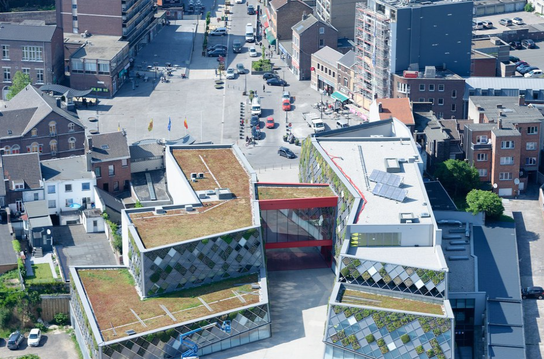
In order to improve its citizens’ quality of life and to restore dynamism to its urban framework, currently marked by industrial decline, starting several years ago, the City of Herstal has initiated a global renovation process of its developed spaces, with special attention to places with dense population.

This process is notably translated by the implementation of the urban renewal master plan, concerning a large area at the center of the municipality where over 7,000 residents (representing almost 20% of the population) live.

This drive to boost the attractiveness of life in Herstal will lead to multiple projects, particularly with the support of the ERDF, regional subsidies, and private partners, including the construction of a new municipal plaza, the creation of parks and gardens, the complete redevelopment of the boulevards that go around the city center, the cleaning up of industrial wastelands and the freeing-up of spaces for the construction of housing, community spaces, and businesses that are compatible with their environment.
Document Actions
banniere-hall.jpg

herstal_banniere_agenda.jpg


liege expo 2017 - couleur rvb.jpg

« Février 2012 »
Février
LuMaMeJeVeSaDi
12345
6789101112
13141516171819
20212223242526
272829
Herstal bouge !
liège eco_portlet.jpg
 
La météo à Herstal
Fonds Européen
Le Fonds européen de développement régional et la Wallonie investissent dans votre avenir
http://europe.wallonie.be

feder-ue+w[1]_portlet.jpg

Firefox
Ce site est optimisé pour le navigateur Firefox.

Sécurisé, fiable, rapide, Firefox est conçu selon votre manière d'utiliser Internet.
Gratuit et simple à installer!

firefox.jpg
Ce site est optimisé pour le navigateur Firefox.

Sécurisé, fiable et rapide, Firefox est gratuit et simple à installer.